
The components of
a Good Decision.
CONTROLLED GROWTH · CASE STUDY
Choosing Priorities before Payoffs
A wealth manager wanted to provide his clients with both growth and protection. The first challenge was deciding which objective should take priority.
This case study illustrates how establishing those priorities before designing the payoff led to a better balance between upside potential and downside protection.
31.56%
RETURN CAP OVER
2-YEAR TERM
2 YR.
MATURITY
SINGLE OBSERVATION
1:1
PARTICIPATION
UP TO THE CAP
30%
DOWNSIDE PROTECTION
TO A 30% DECLINE
THE PAYOFF
STRUCTURE
2-year capped participation note
UNDERLYING
S&P 500
UPSIDE PARTICIPATION
1:1, capped at 31.56% over the term
CAPITAL PROTECTION
Full, down to a 30% decline in the index at maturity
BEYOND THAT
Capital returned 1:1 with the index's decline
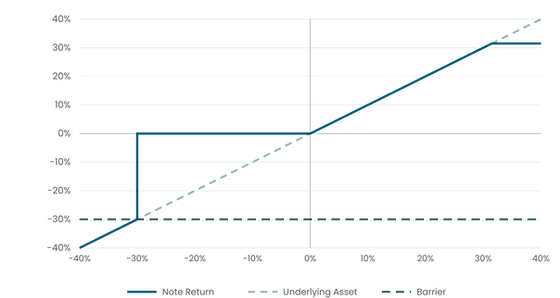
Capital is protected to a 30% decline, with upside participation capped at about 31.56%.
S&P 500
NOTE CAPITAL RETURN
-40%
$60,000
-20%
$100,000
0%
$100,000
20%
$120,000
40%
$131,560
Note capital return at maturity, versus the S&P 500.
Illustrative, based on the terms above. Initial Capital of $100,000.
Follow Up Q&A
01
What happens if the index falls below the barrier?
If, at maturity, the index is below 70% of its starting level, the barrier has been breached and capital is no longer protected.
From that point, capital is returned in line with the index's decline, 1:1.
For example, if the index finishes down 30%, the investor receives 100% of the original capital. If it finishes down 30.01%, the investor receives 69.99% of the original capital.
02
What happens if the index rises above the cap?
If, at maturity, the index has risen more than 31.56% above its starting level, the note's return is capped at 31.56%, regardless of how much further the index has climbed.
There is no participation in any gain beyond that point.
03
Why a 2-year maturity rather than longer?
For participation notes, we typically recommend staying within the 2–3 year range. Longer maturities tend to work against this type of structure in three distinct ways.
First, the protection becomes less meaningful. The barrier always protects the original investment, but over time a successful investment can become worth substantially more than its initial value. At that point, protecting the original $100 matters far less than protecting the investment's current value. The longer the maturity, the greater the chance that the protection remains intact on paper while no longer protecting what the investor actually cares about.
Second, liquidity becomes more expensive. Participation notes can usually be sold before maturity, but the relevant question is not whether liquidity exists; it is the price of that liquidity. Because the upside is created through an option rather than direct ownership of the index, the note will typically trade below the index's own performance while markets are rising, with that discount narrowing as maturity approaches. The longer the maturity, the larger that discount can become. Selling early therefore becomes increasingly costly, even when a secondary market exists.
Third, the cap becomes more likely to matter. A capped return is rarely a problem if markets rise moderately. The issue arises when markets continue rallying well beyond the cap. At that point, the investor faces an uncomfortable choice: continue holding an investment that is now clearly underperforming the index, or sell early and crystallise that underperformance. A shorter maturity simply reduces the probability of ever facing that dilemma.
04
Why the S&P 500 rather than a more growth-oriented index
The objective of this note is not to maximise upside. It is to achieve an attractive balance between participation and downside protection. That makes the choice of underlying just as important as the structure itself.
A capped participation profile naturally fits some indices better than others. The cap is not there to limit returns. It is there to make the downside protection possible. The objective is therefore to strike the right balance: a cap that is high enough not to become too costly for the investor under most market conditions, yet not so high that it provides too little downside protection.
The Nasdaq illustrates this well. Compared with the S&P 500, its stronger tendency towards outsized rallies means a capped participation structure is more likely to leave meaningful returns on the table. That does not make the Nasdaq a less attractive investment. It simply makes it a less natural fit for a note designed around these parameters.
The S&P 500 is, in our view, a better match. Its historical return profile makes a cap of approximately 31.56% over two years a very reasonable trade-off: high enough not to give up too much upside in most market environments, yet low enough to provide meaningful downside protection.
05
How did it play out?
Over the two years, the S&P 500 rose 37.91% in price terms and 40.41% on a net total return basis, including dividends. Because the index finished well above the 70% barrier, the investor's capital was fully returned. Because the index also rose well beyond the 31.56% cap, the note delivered its maximum return.
Judged on its own terms, a 31.56% return over two years is a strong outcome for a Controlled Growth objective and well within what the note was designed to deliver. Judged against the index, the note still captured approximately 78% of the S&P 500's net total return, despite this period producing exactly the kind of sustained, unusually strong rally in which the opportunity cost of the cap is expected to be greatest.
The cap did exactly what it was designed to do: it gave up some upside in exchange for meaningful downside protection. In this case, the trade-off proved meaningful, but not excessive.
06
What made this a better decision?
The decision didn't depend on correctly anticipating how strong the market's rally would be. It depended on setting, in advance, a specific and deliberate trade-off between upside and downside - a fundamentally more answerable question than trying to predict where markets would go.
That trade-off was set with a clear-eyed view of what it would and wouldn't cover. A 30% buffer is not a modest one: over a two-year period, it covers the great majority of realistic market declines for an index like the S&P 500, short of a genuinely severe crisis. The note was not designed to protect against that kind of extreme, low-probability event. Doing so would have required a much lower cap, undermining the very objective the note was built to serve: meaningful participation in the market's upside while protecting against the declines an investor is actually likely to encounter.
That is precisely the balance the outcome reflects. The market delivered an unusually strong rally, the kind of scenario where a cap costs the most, yet the note still captured the great majority of that return while carrying no capital risk at all. The decision wasn't to eliminate risk. It was to define, in advance, which risk was worth taking on, and which wasn't.
*Qualified/Classified Investor, as defined in the Securities Law - 1968.
© Oasis Investment Solutions | Oasis IS Ltd. All rights reserved.


